Friday, April 30, 2021

ATOS Control Cable Twist....


A recent Facebook post on the “A.I.R. Atos” user group brought up the suggestion that a twisted control cable incident may have caused a crash:

From Face-Book, post crash, the "cable twist" :


I was skeptical that the twist would disable the system, but my curiosity got the best of me.  I decided to give this a closer look (in particular, the suggestion that this “wrap” caused both spoilers to deploy at the same time).  

 With my wing setup for its spring pre-flight I tried to simulate the wrap shown above (on one side, then both sides). Admittedly, it was not easy to get this much twist to happen. The only way I was able to create a fixed twist in the cable was to jam some short sticks in both wire sets to get them to hold the “twist”.  Without the artificial effort, they tended to completely un-twist with any amount of control input.  

Eventually I managed to simulate the twist and yes, it did cause resistance and yes it did cause both spoilers to lift off the wing (or, more accurately, did not allow them to return to the normal closed position).

 What was obvious during the control check, the control bar movement was not smooth and there was substantially more resistance than a normal control check. This unusual resistance would have inspired some further investigation.  

 So lets start with the obvious (and I'm pretty sure the pilot involved would agree....), a proper PRE-FLIGHT INSPECTION was not done and would have caught this twist (if indeed the twist was present prior to launch). In this scenario, the site is windy and exposed, as I understand it, pilots make a habit of leaving the side wires disconnect (to avoid wear of the nose control cable).

 I am not totally convinced the twist was present pre-launch.   Finding the twist post crash may not be proof that the twist was there at take-off. (tho… the pilot’s description does suggest something was wrong with the controls during takeoff).

 There exists the possibility that the crash had stretched the spoiler cables. Any impact strong enough to damage a control bar weak link creates the opportunity to cause control cable stretch (more precisely, tighten the twist and or “set” the twist of the cable).  Of course these control cables have very little stretch, but because of the length of this cable, they can develop and store a substantial amount of twist (force) and in this situation may have caused the cables to twist “post crash”.

 Here is some basic information on cables and the type of stretch related to its construction:

 https://www.cmacable.com/wp-content/uploads/2017/05/1704constructional-stretch-1.pdf

 A fresh set of “new” control cables will not tend to twist the connections of the control system. A few high load incidents can cause cable stretch and create enough twisting effect in the cable that it will cause the support block to roll over and twist the cables (and yes, even with the spoiler end of this cable being a soft/flexible mount of the spoiler cord on the outboard section of the control system).

 During setup, there should be no need to twist the shackle fittings to straighten or compensate for any twist found in the spoiler cable and its support block. Even with a very weak bungee support cord. These cables should line up without any need to force or twist any part of the connection.  If you find that the block twists more than 90 degrees when the system is connected, you need to correct the problem.

 A new cable might be in order, or at the very least, a careful inspection.   If you are sticking to the original cable set, then it will be necessary to disconnect one end of the control cable, let the cable “relax” and roll / twist to its normal alignment, then re-connect. The spoiler cord end is one option, but I find the better option is to correct the issue at the nose/support block end. This makes it allot easier to figure out how much twist is involved and access is allot easier then mucking about with the cords, knots and settings of the outer attachment.  

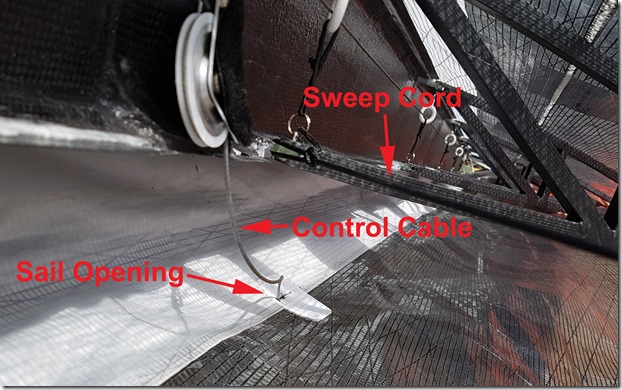
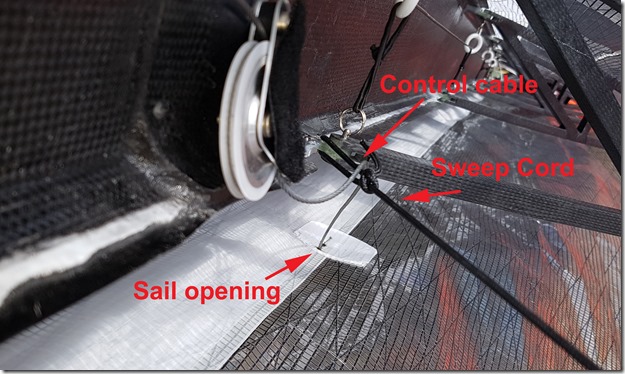
 Outboard control cable end (buried inside the sail):


Inboard end connection (cable removed):


 The other reason you might want to work with the support block end is you will need to cut off the shrink wrap anyway to refresh your support bungee. If your replacing he bungee for the first time, be sure to use the material used by A.I.R., some bungee material may look the “same” but may be too strong for this application.

 Caution…There is a bunch of work that might put you off, like needing to use thread locker products, the lock tab, even the possibility that the bolt strips out of the soft aluminum connecting block... such is life, if your uncomfortable working on your glider, get help.

 Cable connection, assembled and with a proper natural alignment:


Another point to consider, do not try to solve a twisting issue by simply refreshing or installing a stronger support bungee (to get the bungee to pull the twist out of the system).  The only purpose for this bungee is to support the weight of the connection block and maintain a light tension on the spoiler cable. 

As to the suggestion that a twisted control system caused the crash in the Face Book post? Yes, it is possible. A combination of way too much control system play (greater than 1” of travel in the control bar movement before actuation), a weak bungee cord , a twist loaded into a stretched wire and a lack of pre-flight inspection could be just the right combination of things to get this very simple control system to fail.   

 If there is any tendency to twist when you are making the control system connection, you need to correct the problem. 

Of course, this incident could have been caused by other known issues such as the factory advisory regarding nose pins:


 Or if you have an older wing with Dyneema control nose line:


 Or as mentioned on a earlier blog post,  your control wire gets pulled back up through the sail access and you inadvertently cross your assembly sweep cord: (http://towforce.blogspot.com/2018/04/air-atos-q-series-set-up-error.html )


Without question, the ATOS control system is amazingly simple and safe if you do a proper pre-flight inspection.

If you are not going to complete the setup of the control system (because of circumstances related to where you fly), the nose cone must be left off and lower surface unzipped (An ATOS is this configuration must be considered as, not ready for flight and a complete control system check is required). 

Any time you connect the control wires to the control bar, you must visually inspect the internal wing connections and routing, you must complete your control system check and of course, you must close the zipper and install the nose cone for flight. 

DO A PROPER PRE FLIGHT. 

Believe it or not, I have had pilots tell me that during their pre-flight something felt odd, but they flew anyway! Yikes!… if something does not “feel right” track it down! Remember, the spoilers on an ATOS are kind of important (just a bit of an understatement?)… don’t leave home without them 😉

 Cheers and Fly Safe!


Tuesday, June 9, 2020

My Accident Report, Woodside May 27th 2020

(Previously posted on the West Coast Soaring Club Incident Forum)


Woodside Accident Report:
May 27th 2020,

I would like to start this report with a few comments. First and foremost, I’ve done many accident reports through the years (primarily for others) and it’s a privilege to be able to file this (a)live!

No matter how long you have been flying, you can never stop focusing on safety. It’s a high risk game and mistakes can be fatal. Please…. Share your mistakes so others can learn. This report is about how I let my guard down and allowed complacency and distraction to creep into my decision making process. The mistakes I made nearly ended my very long flying carrier.

The Accident:

On May 27th, 12:30, with light and variable conditions, I was attempting to launch my rigid wing hang glider (ATOS VQ-Race) off Mount Woodside in the Fraser Valley.
The conditions on launch were warm with clear sky, slightly thermic, with an inconsistent, variable breeze coming into the launch ( 0 – 5mph, generally “up the hill”). Hooked in and on launch getting ready to go, it took several minutes for conditions to yield a favorable cycle.

I picked up my glider and started my run. Within the first few steps I immediately noticed that something felt wrong. The glider felt heavy and I recall a “not quite right” sensation (which may have caused me to hesitate my stride?).

One or two more strides further into the launch run, I felt the glider was getting ahead of me and not lifting. Now totally committed to the takeoff, I was trying to keep up with the wing. In a desperate effort (too little too late), I went prone in my harness, grabbed the base and pushed out to try and save the takeoff. Too little too late, with obviously not enough airspeed, I was starting to settle back onto the slope. The control bar base tube began catching some low brush and the rock covered terrain. Very quickly, the control bar failed and crumpled at the weak links (more on this later).

With the control bar collapsed and me dragging across the terrain like an anchor, the glider pitched/flew forward, nosed over and rolled itself upside down and ended up inverted and pointed back up the hill. I distinctly remember hearing the awful noises of what sounded like my Carbon wing grinding to a halt. As the glider and I “nested” onto the hill, I ended up on my back, laying on top of the inverted undersurface of the wing. My very first thought was… “Shit… this can’t be good for my glider!” (Seriously).

It took a few seconds to assess my condition. I was pretty sure that I had some injuries but my initial assessment made me think they were minor, gloves, helmet and harness appeared to have done their job. I did a quick look around to see if the event was finished… (like Willy Coyote sitting at the bottom of a cliff waiting for a rock to come tumbling down the hill…..). Everything seemed stable, though I was still uncomfortably trapped with my harness strapping me to the wing. I then realized I had a witness who was probably thinking they just saw somebody die…. So I did the customary shout out that I was “OK”…. Stupid and embarrassed, but “OK”.

As the witness arrived, I managed to get unclipped, got myself off my wing. Pretty sure I made some sarcastic comment about the flight being much shorter than expected and moved onto the “what’s next phase”.

My next concern was the thought that…oh, oh… likely somebody down at the FlyBC ranch probably saw this and would be calling 911…. Arrrrrgh… evening news stuff. As luck would have it, Jim from FlyBC had just arrived with his usual bus load PG pilots that made up my rescue crew. After a few minutes I was able to catch my breath, get out of my harness and flight gear and coordinate the newly recruited recovery team into getting my glider back up to the setup area. (Special thanks to all of those that gently carried by baby back up to launch!)

Post-Accident Assessment:
Back on top I assessed myself for injury. My wrists were pretty sore (left wrist had some swelling, but I figured since I was still able to use the hand probably not broken). I also had a bunch of other scrapes, scuffs and bruises, no doubt were going to hurt later on when the adrenalin started to wear off. (For sure it was going to be an evening with Dr. Motrin and his nurse, Ms. Ice Pack)

The Glider…. this left me amazed. For anybody who has ever owned anything Carbon, you can appreciate how the material is both amazingly strong and at the same time very fragile. You don’t try to “fly through rock” and expect a very good outcome.

The first and most obvious damage, the control bar appeared to be a mess. This beautiful sculptured carbon fiber work of aerodynamic art was all twisted up like a pretzel. Upon closer inspection, other than some slight cosmetic damage (Downtube alignment pins) the control bar was in fact in great shape.

As a bit of a comment, what makes the ATOS downtubes special is the short length of stainless steel tubing inserted in the middle of each downtube. It is designed to crumple, absorb energy and allow the downtubes to fold in a hard landing well at the same time stop the glider from nosing over and drilling the pilot in the back of the head with the nose plate. Depending on how creative the pilot is, it does not always break/fail as designed but lucky for me, the brilliant design of the ATOS downtubes probably saved the day. (I was able to replace two of the weak links on launch, allowing me to continue the inspection with the glider upright and back on a assembled control bar.)

Next up, my biggest fear…. What had the crash done to the Carbon fiber leading edges? (To be clear… I was not trying to assess the glider for airworthiness on launch, that would come several days later with a full airframe inspection.) Much to my surprise, I was inspired by the basic inspection that found NO damage…. Given I had just try to fly my baby through rock, I was blown away. The net damage to the glider (after a full inspection several days later) was two bent downtube weak links, a bent control bar pip pin with one downtube required a minor carbon repair to an alignment pin, a very minor tear in some leading edge sail cloth (Dacron patch) and lastly some green and brown cosmetic stains across the span of the leading edges from where “mother Woodside” clawed me back to earth. (or perhaps cradled my dumb ass back onto the ground?)

All in all, both myself and my glider survived the ordeal.

No question, I was Lucky…. VERY Lucky.

Accident Evaluation:

So, now the question….. “What happened”?

The simple answer is…. I blew my launch. (Thank you Captain Obvious).

In my 45+ years of flying hang gliders I have never considered myself to be a gifted pilot. I have to work hard at flying safe and success does not come naturally. Woodside is my home site. I’ve logged hundreds of launches from this site, many of those launches in similar conditions to what I had on this day. So why was today a problem? After carefully assessing what lead to the crash I suggest it all boiled down to a few fundamental mistakes.

I started with the nose too low and flew the glider into ground. (Now that’s embarrassing). Truth is, I have always found launching a rigid wing hang glider, way easier then launching a flex wing hang. They seem so much more efficient at creating lift. There is no inflating the sail, the whole airfoil begins to generate lift from the moment you start to move through the air. As nice as this launch characteristic is, rigid wings do have one minor flaw. Some have described this flaw as a “sticky pitch”. The essence of this flaw is based on the pitch curve of a rigid wing hang glider.

The pitch curve of the ATOS-VQ is very near neutral but still considered to be “stable”. Perhaps, better explained as, when in flight putting the nose “down” (speeding up) will see the glider eventually return to trim (the speed that the glider will fly hands off). This “near neutral” characteristic is even more dramatic if the glider is not loaded via the hang strap and pilot. To deal with this characteristic on launch, all you have to do is have a slightly higher pitch setting during take-off, the glider will then lift and find its own “trim” as the glider is loaded. As I see it, my fundamental mistake was setting the nose too low and essentially flying the glider into the ground. (not certain, but I think the witnessed may have filmed the launch but left before I had chance to ask him… so maybe, somewhere out there in F-Book land or YouTube could be a video of my epic fail…. Post a link if you find it!)

In addition to the mistake of setting the pitch too low, I feel I made other accumulative mistakes that likely contributed to the accident. If you want, you can call them my little list of excuses….

I have thousands of hours of experience, hundreds of takeoffs from this very site yet I now feel the simple rule of maintain my foot launch proficiency was at the root of the mistake. From an “experience” perspective, my foot launches are starting to get rusty. In the past 10 years, nearly all of my launches have been from tow. My foot launch numbers have started to dwindle to perhaps less than 5 or 6 launches a year from Woodside (and no other foot launch site). That “rust” (such as the memory reflex that I rely upon for my pitch setting) should have inspired a more careful consideration of the launch conditions. You can get caught in a trap if you think your years of experience will automatically apply to the task in front of you. I had become complacent and should have given my “rust” greater consideration and should have waiting for more optimal launch conditions (after all, there was no pressure to launch as I was the only pilot there).

The choice of launch position was also a mistake (the spot that I had chosen to start my launch run). I decided to not use what I would normally consider to be the optimal takeoff path for these light and variable conditions. To explain my decision I should start by saying, the ATOS has a very wide wing span (44ft/13.2m). Paraglider pilots that use this launch have installed a windsock on the south side/edge of the take-off area. The position of this wind indicator does limit my options as to where I position myself for takeoff. On days where the wind has a more southerly component I will often ask that it be removed. On this day, wind conditions did have a southerly component and were very light. With only a spectator on launch and already clipped in, I made the decision to launch to the north of the sock.

This launch choice is not as steep, has some vegetation and could be considered a bit shadowed and potentially a thermal trigger point with “dead air” caused by the vegetation. Given the light conditions I should have not compromised my options.

BTW, the position of this sock has been something I have tried to deal with in the past. I’ve tried to have this sock moved to a position lower down on the south slope but it keeps migrating back up the hill by the PG community. Not blaming anybody as I easily could have asked for the sock to be removed but I don’t believe the paragliding community fully grasps the safety risk it creates… a risk that I should have dealt with myself.

Last on my list of excuses… a little thing about the psychology of flying, or as I like to call it, a “head full of distractions”.

We all have them… those day to day “things” you experience and store in your head. Most good pilots can compartmentalize this stuff and put those “things” away, not allowing them to interfere with the task at hand. Thing is, having investigated many crashes through the years I am well aware that distraction has proven to be a major influence on how a pilot handles the decision making processes. We should never have a head full of issues when we get onto launch. The problem is, you need to identify when the distractions are getting out of hand (or cannot be ignored).

For example, in my crowded little box of distractions….

There is this Covid Pandemic thing out there. Unless your living in a cave, this topic can’t help but linger in the back of your mind. My work, my summer flying plans, my local flying all get to share space in my brain with this “little flu”.

Also, on the list of distractions was a great sadness that I have started to develop regarding “My Mother Woodside”. Woodside is the only site in the lower mainland that I can fly my rigid wing. It’s truly very sad how my favorite flying site of the last 40+ years has been decimated/raped by all of its users. The road has taken a pounding, there are no more peaceful times to be had without crowds. We now see (more than ever) vandalism, garbage and destruction of our launch (I mean, for God’s sake… how many times can you put a bullet in a defenceless out-house?) . The crowding and use has reached the point I can no longer bring myself to fly the site on a sunny weekend. I now have to time my adventures to rare mid-week trips.

On the day of my accident, I had deliberately gone out early with some garbage bags, rake and shovel just to clean up the mess of multiple fire pits and garbage on launch (some of the limited space in my head was also being taken up with special thoughts regarding my fellow humans that feel crapping on our beautiful launch is something they feel obliged to do….)

Next distraction, the flying conditions.

I had hoped my planning for this weekday flight was going to pay off with a rewarding cross country. Unfortunately as launch time approached it became obvious the conditions were crapping out with the dreaded stabling out of the Fraser Valley air mass. As I got out to launch I was truly doubting I could get to the high ground needed to go XC. I know for sure, my attitude on launch was “let’s get this over with” (oh, my…..”negative waves Moriarty”… famous movie quote by Donald Sutherland)

Lastly, like all of us, I have my own little sack of “Life’s little distractions”… they were generously tossed into the mix probably not that helpful.
I suspect, on this day I did a poor job shutting the distractions out but being on the hill there is no question my focus should have been on flying. It might even have been a good time to ask myself, should I be flying?

Hopefully, if you have managed to make it this far in my report…. I suggest there are a few takeaway/lessons to be had.

Maintain your skills. Don’t let experience turn into complacency, or worse let all of your experience create a false confidence.

Don’t let the “rust” build up. Know your skills and be honest about what it takes to maintain those skills/proficiency. If your skills are starting to suffer, improve your odds by accommodating those weaknesses, pick better conditions, pick a better time or just take the time to knock off the rust (hopefully by not attempting to fly through rock?).

Focus on the task at hand. Do not ignore things that may have an influence on your decision making. If faced with challenges where options could improve your situation, do not ignore the opportunity to change/improve your plan.

Heck, maybe just avoid trying fly through rock?

Cheers and thanks for your time.

Fly Safe!

Martin Henry

Sunday, October 20, 2019

VR 2006 For Sale

I have decided to put my Old 2006 VR up for sale.

I had planned this glider to be part of ultralight sailplane or trike project but its becoming pretty obvious that I'm never going to get around to it so perhaps its time to see if someone wants to put this fine ship back into the air?

It is a long tail version of the 2006 World Championship wing with fixed tip ribs and refitted with a ODL Technora Hybrid sail  (part Dacron and Technora).  There is roughly 250 hours on the sail, very good condition and has plenty of airtime left.  Total air-frame hours is just over 700 hours.


There has been some minor D-Cell and ribs repairs over the life of the wing and is currently in excellent airworthy condition.

Being totally honest here, this rigid wing is not for "just any pilot". You need to be confident in flying high performance and need  solid pilot skills to own/fly this wing.

This is a wonderful aircraft to fly but must be respected. Owing and flying a rigid wing requires much care and respect. It's a beast to transport at 105 pounds, tail heavy to handle on the ground (but easy to launch), has almost no bar pressure at high speed and can be challenging to land.  That said, the VR has performance to spare, wonderful to fly and IMO, can keep up with even the latest production gliders from A.I.R.

I'm asking $7500 Cdn (roughly $5800 USD) and firm on the price.  The price will include a few minor parts (DT weak links and Dyneema nose cable). The glider is currently fitted with custom one piece bag but for an additional $400 I can make a split bag setup to make transport a breeze.

I have flown many High Performance flex wings but after converting to a rigid wing... I would never go back. Performance, control and confidence in big rough air sums up my reason for never wanting to go back to a flex wing.  If your interested, send me note at towforce@gmail.com (note: I do not want to ship this wing and a potential buyer will need to pickup or arrange an agreeable meeting location).

Cheers

Martin


Saturday, August 3, 2019

40 Years !

(Its been over a year so I guess its time post something?)

It's our 2019 Mansfield Encampment and we recently had a minor celebration here...

Mia (my ever "enduring" partner 😏 ) recently surpassed a little milestone in her flying carrier. After a recent local Mansfield 62km FAI triangle she was able to claim 40 years of hang gliding!

Over the last year she had not been flying much as she had been hard at work focusing on attaining her teaching certificate from the University of the Fraser Valley.  She successfully graduated a few weeks back and after a bit of "decompression" has started to get back into the swing of things. Just prior to her hang gliding flight she bagged a bunch of Paraglider flights (so was able to claim 40 years of "flying") but wanted to make it 40 years of hang gliding. 

Of course 40 years of Hang Gliding is nothing compared to the 47 years she has put up with me!

Congratulations Mia, I'm proud of your achievements....


Thursday, August 2, 2018

2018 Mansfield Encampment


In the past I would often try to put together daily reports on our flying in the Columbia Basin, honestly... I'm getting lazy...  Seems I would rather sit out on the lawn chairs with a beer watching amazing sunsets than hash out stories of the last bit of airtime. 


Truth is we fly allot less then in the past. I'm not getting any younger and this place is so industrial its hard (and sometimes not that much fun) to huck yourself at the sky on a daily basis. 

The expression, "Quality over Quantity" seems to have become the goal. We no longer have a big group of pilots, we seldom put more than two gliders into the air at once. Most days its only one glider. Of course this allows for some quality ground support and of course, Class A pampering on the "rig". 


This year's 2018 season had been pretty typical. In the early part of July, the PG pilots had a big contest at Chelan Butte. I'm always blown away with how well the Paraglider pilots do in the big air of the Basin.  Nicole McLearn has an excellent blog on much of the activities, well worth the read:


This years Paragliding Contest saw some interesting lines up the Methow Valley and a pretty cool run up to Orville at the Canadian border.  Once cancelled task saw a small group head off to the Idaho border (200+ kms from the Buttte)

Primarily, we are after the big triangles. The "Big One" is the 300+. Mike Bomstad has the official best from our crew, I've come close but not yet claimed the prize (298 and a 317 non-FAI flat triangle). Mia's goal remains the 200... Or just having fun! Regardless, we no longer bother flying if the wind or forecasts won't allow us to make it home.  Much of this years trip saw triangles confined to the area around Mansfield as forecasts and winds made anything big to the SE unlikely so we stuck close to home, or as we call it, "on top". 

There is one exception to the triangle attempts.. The run to Wilbur WA for a the Classic drive in experience at "Billy Burgers"! We make the goal, Wilbur airport, say hi to some friends at a crop duster facility and head into town for the Billy Burger combo.... of course, anybody sinking out in the area is always a good excuse to at the very least take on a shake for the rest of the retrieval. 

I will followup this post with a couple posts about some special flights from last week but will say that like in many of the past years, smoke has put a damper on this years encampment.  Not too many local fires (been a pretty good year considering how dry it is now), but fires up north in Canada have been drifting their smoke in the light NW winds.  The biggest issue with smoke is it causes the day to start later and end earlier then the soaring models predict.   To break the 300 out here you need a good 7-8 hour day.... especially when you fly as slow as I do!

Cheers

Martin


Tuesday, April 24, 2018

A.I.R. ATOS “Q” Series Set Up Error….

The “Q” series by A.I.R. represents all of the model ATOS’s that use the “Quick Setup System”.  Typically the set up process includes connecting one wing “half” to the other and connecting a sweep cord that stabilizes the two halves during the setup process.  Recently, posted on the Yahoo Rigid wing forum there was an incident where a set up error was made and miraculously did not have a fatal outcome. For clarity, I thought I would post an example of the mistake and point out a minor change that would greatly reduce the likelihood of this sort of mistake being made.

Here is an example of the correct configuration of the control rigging during the setup process:

Correct Rigging

Here is an example of the error made during setup:
Wrong

Ok, for sure this is bad news for the control system. And yes, a proper preflight and control system check would have turned up the fact that something obvious was wrong. Still, the pilot got into the air with the glider rigged incorrectly (and was very fortunate to have maintained enough control to get the glider back onto the ground…. )

Apart from the improperly rigged glider and the poor pre-flight, how did this happen?  I assume one of two possibilities could have resulted in the control system being rigged wrong:

-The Sweep cord fell back into the wing/sail prior to its connection to the keel. The pilot then reached into the sail to the anchor point of the sweep cord and located the cord but was “in front” of the control cable and pulled the cord out of the wing but on the wrong (front) side of the control cable.

-The second possibility was the control cable was accidently pulled through the sail opening during the setup (control bar end of the cable). The cable, now loose inside the sail was incorrectly re routed back through the sail but overtop of the Sweep cord.. (Of course, it could have been a combination of both mistakes?).

For sure, a proper PRE-FLIGHT-INSPECTION would have discovered the problem. Still, even if the the problem was discovered the mistake could have resulted in damage being caused to the sail or cable during the rest of the assembly process.

To avoid/reduce the potential of making this mistake I suggest all Q series owners make the effort to use a small velcro or Neoprene protector on the control bar end of the control cable. Not only will this protect the sail and flaps from damage caused by the hardware on the cable end it will help prevent the control cable from accidently being pulled through the sail opening during the setup.

20180422_102223

For those inquiring minds that want to know if this is something that I did…?…. Nope, not me but I do thank the pilot that posted the incident on the Yahoo Rigid Wing forum.  A pilot who I’m sure will be more then happy to do a proper pre-flight the next time out!
Cheers

Tuesday, January 23, 2018

Barry Bateman, HPAC Member #1

In the month of November 2017, the Canadian hang gliding community lost one of our “old timers”. A true driving force of the early days of the HPAC and flying in Canada, Member #1, Barry Bateman.

After what Barry himself defined as a “full life and can’t complain”, he accepted his fate and lost a short battle with an aggressive cancer. Barry caught his ride to what-ever might be awaiting him on the “other side”.

Thinking back about Barry’s contributions to Hang Gliding in Canada I should start by clearing up the story behind Barry’s HPAC #1 membership. No, Barry was not the first member of the HPAC. The truth is, Barry had learned to fly in that far off fog bound little country of proper queues and a stiff upper lip; England.

During the mid 80’s, the HPAC was going through a bit of renewal with many of us, including Barry were participating in the various HPAC/ACVL director positions. Barry insisted, core to a national organization should be a “News Letter” (a method to communicate and bring this vast country together). We also needed reliable membership services that included ratings and a membership cards (Barry brought over from England the values of “Clubs”… very British….). Barry insisted that rather than relying on volunteers, the time had come for the HPAC to have a paid administrator. A few of us argued, but like all things involving discussions with Barry it was futile, so it was agreed, Barry (who was looking for a little part time work…that would, of course allow him lots of flying time!) would take on the first paid position of HPAC Administrator.

The first order of business was to update and create a new database (something super high tech… I think it was a high jacked copy of Lotus 123?). According to Barry, there was no logical way to translate the old numbers into the new database. Trust me… the explanation seemed reasonable as Barry did seem to spend days hunkered down in front of his IBM 386XT working on the data base … or maybe he was just playing pong?

Like all great nations and organizations, rebirth would include “corruption, collusion and opportunity”. Barry made his first entry into the database: Barry Bateman, membership #1 !
I protested… so I received #2 (personally I believed my protest was valid, after all I was the President/Emperor of the HPAC/ACVL at the time….). In the end I gave up and let Barry have his #1. I figured if those pesky members got restless the first lynching would involve #1.

Barry also took on the role of National News Letter Editor. He was a true ink stained wretch of the Fifth Estate. He took the task “full-on”. He hounded every director and member for material and he published on schedule, no exceptions. In the late 80’s, he taught himself to use the cutting-edge software of the day, Aldus PageMaker. I remember on several occasions the newsletter was coming up short on content and I made the big mistake of suggesting, “why not delay the publishing date”? Yikes!... with clenched teeth he responded with “I will publish blank pages before I push off a print schedule”! That was Barry.

I remember one year, Barry booked a vacation to one of his most favorite places on the planet, Australia (I thought I should mention his love of Australia because if there was one place on the planet he could drone on and on about, it was the wonderful land of OZ!). The thing is, the HPAC did not offer any sort of Union labor standards for time off and he still needed somebody to put out the newsletter. Skillfully, he sucked me into learning how to use his Pagemaker template. Somehow, we (the HPAC) survived (I think I can still taste the glue of hundreds of licked stamps and envelopes!).

I must say, with this being my first and albeit short tenure as HPAC editor, Barry did teach me a very important fact regarding the publishing of a periodical. The actual content of an article is unimportant! As long as the number of words filled the allotted space and did not interfere with a nice picture you were as good as gold (More than few times I heard Barry use his favorite phrase “no problem” ! ) Based on what I see in the various periodicals that I read today, “word count” over “content” is king.

Of course, when Barry returned from Oz he offered up his traditional “Bateman appreciation” … he complained I was 2 weeks late getting out the first of my editions… ungrateful little….
For well over a decade, starting in the mid 80’s Barry doggedly pumped out 4 national newsletters and made sure “paid” members got their membership cards.

Along with his major contribution to the early operation of the HPAC Barry was one of our leaders in the flying community on the West Coast of Canada. He contributed as an instructor and dealer of UK gliders like the Magic and Magic Kiss. He was also a competitor and organizer of many of the hang gliding comps that occurred during the 80’s and 90’s. One of the more notable contests, the Cache Creek Team Meet. The contest would often be the seasons wind up bash. It promoted team flying… or at least creative team names!

Well visiting Barry in hospital, we reminisced the “old days” and both agreed that the 90’s (and slipping into the 2000’s ) for Hang Gliding, was the “Golden Age” for the sport.
The contests, the politics, the organizing and the flying, Barry through his heart into to all of it. As a pilot he was always the “little guy” on a “big glider” that would tenaciously out sink, out scratch anybody who tried to climb to the top of the pack. Like I said, everything was done with passion… and a little English “Bull Dog” pride.

I will always remember Barry’s “No problem” attitude toward flying and its community. He worked with great passion to bring this great big country of Canada under the umbrella of one national organization. He could drive people a little nut’s in the process, but after all, deep down…. He was English!

In later years Barry drifted away from hang gliding and onto the new passion of sailing. He married, bought a boat and sailed the “the big blue”. His adventures had him sailing the many distant ports of the Pacific.

Barry would often chastised me for not getting out of my flying rut…. “there is more to flying than just hanging around here, you should get out there and see the world”!

My reply would always be the same, “the dirt in Mansfield Washington is no different than the dirt of the Ozzy outback… and ….of course, without all the infamous Ozzy snakes and spiders” …. he would laugh.

Which brings me to this…..

In sports, a team will often show respect for key players that help define or contribute to the history of the team by retiring a players Jersey and number. I think it would be a fare tribute for the HPAC and its members to at least symbolically recognizing Barry’s #1 “virtual” Jersey up into the rafters. A bunch of us old timers from back in the day would be more than happy to hoist a glass and say “Cheers”.

Martin Henry
HPAC Member #2 😉